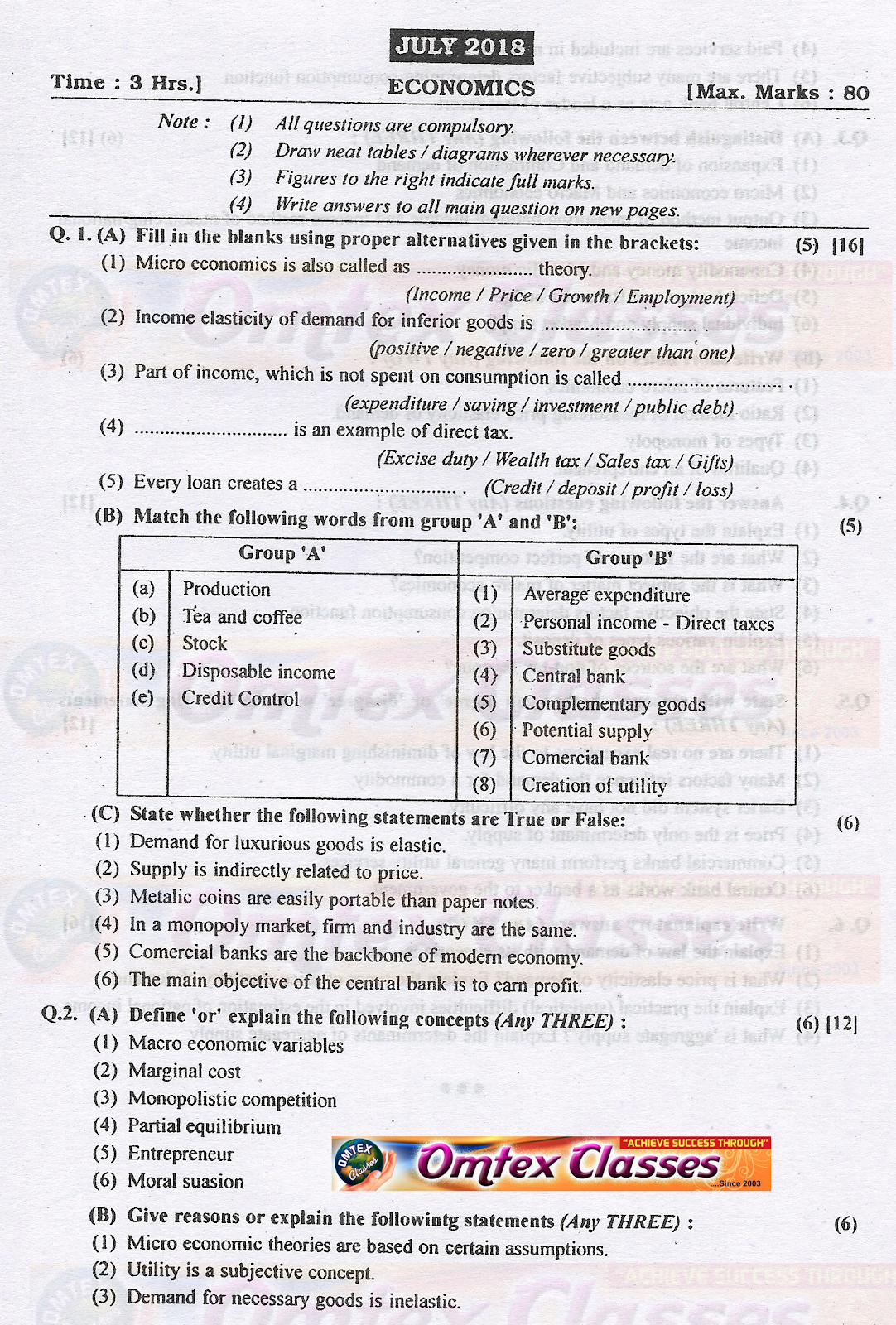

JULY 2018 HSC ECONOMICS BOARD PAPER
Q. 1. A. Fill in the blanks using proper alternatives given in the brackets.
(1)
Micro economics is also called as ____________ theory.
Check Answer
Answer: Price
(2)
Income elasticity of demand for inferior goods is _________.
Check Answer
Answer: negative
(3)
Part of income, which is not spent on consumption is called ________
Check Answer
Answer: saving
(4)
________ is an example of direct tax.
Check Answer
Answer: Wealth tax
(5)
Every loan creates a ________
Check Answer
Answer: deposit
Economics Board Questions with Solution
- Economics - March 2025 - English Medium View Answer Key
- Economics - March 2025 - Marathi Medium View Answer Key
- Economics - March 2025 - Hindi Medium View Answer Key
- Economics - July 2025 - English Medium View Answer Key
- Economics - July 2025 - Marathi Medium View Answer Key
- Economics - March 2024 - English Medium View Answer Key
- Economics - March 2024 - Marathi Medium Download QP Answer Key
- Economics - March 2024 - Hindi Medium View Answer Key
- Economics - July 2024 - English Medium View Answer Key
- Economics - March 2023 - English Medium View Answer Key
- Economics - March 2023 - Marathi Medium View Answer Key
- Economics - July 2023 - English Medium View Answer Key
- Economics - March 2022 - English Medium View Answer Key
- Economics - March 2022 - Marathi Medium View Answer Key
- Economics - July 2022 - English Medium View Answer Key
- Economics - October 2021 - English Medium View Answer Key
- Economics - March 2020 View
- Economics - March 2014 View
- Economics - October 2014 View
- Economics - March 2015 View
- Economics - July 2015 View
- Economics - March 2016 View
- Economics - July 2016 View
- Economics - March 2017 View
- Economics - July 2017 View
- Economics - March 2018 View
- Economics - July 2018 View
- Economics - March 2019 View
(B) Match the following words from group 'A' and 'B'
Try to match Group A with the correct option from Group B before checking the solution.
| Group 'A' | Group 'B' (Options Mixed) |
|---|---|
| (a) Production | (1) Average Expenditure |
| (b) Tea and coffee | (2) Personal Income - Direct taxes. |
| (c) Stock | (3) Substitute goods. |
| (d) Disposable income | (4) Central bank |
| (e) Credit control | (5) Complementary goods. |
| (6) Potential supply | |
| (7) Commercial bank | |
| (8) Creation of utility. |
Check Correct Matches
| Group 'A' | Correct Match from Group 'B' |
|---|---|
| (a) Production | (8) Creation of utility. |
| (b) Tea and coffee | (3) Substitute goods. |
| (c) Stock | (6) Potential supply |
| (d) Disposable income | (2) Personal Income - Direct taxes. |
| (e) Credit control | (4) Central bank |
(C) State whether the following statements are True or False.
(1)
Demand for luxurious goods is elastic.
Check Answer
Answer: True
(2)
Supply is indirectly related to price.
Check Answer
Answer: False
(3)
Metallic coins are easily portable than paper notes.
Check Answer
Answer: False
(4)
In a monopoly market, firm and industry are the same.
Check Answer
Answer: True
(5)
Commercial banks are the backbone of modern economy.
Check Answer
Answer: True
(6)
The main objective of the central bank is to earn profit.
Check Answer
Answer: False
Q. 2. (A) Define or explain the following concepts. (Any three) [6]
- (1) Macro economic variables.
- (2) Marginal cost.
- (3) Monopolistic competition.
- (4) Partial equilibrium.
- (5) Entrepreneur
- (6) Moral suasion.
(B) Give reasons or explain the following statements (any Three)
- (1) Micro economic theories are based on certain assumptions.
- (2) Utility is a subjective concept.
- (3) Demand for necessary goods is inelastic.
- (4) Paid services are included in national income.
- (5) There are many subjective factors determining consumption function.
- (6) Central bank acts as a lender of last resort.
Q. 3. (A) Distinguish between the following. (Any Three) [6]
- (1) Expansion of demand and Contraction of demand.
- (2) Micro economics and Macro economics.
- (3) Output method of measuring national income and Income method of measuring national income.
- (4) Commodity money and Metallic money.
- (5) Deficit budget and Balanced budget.
- (6) Individual supply and Market Supply.
(B) Write short notes on the following. (Any Two)
Q. 4. Answer the following questions. (Any Three)
Q. 5. State with reasons whether you 'agree' or disagree' with the following statements. (Any Three)
- (1) There are no real exceptions to the law of diminishing marginal utility.
- (2) Many factors influence the demand for a commodity.
- (3) Barter system did not have any difficulty.
- (4) Price is the only determinant of supply.
- (5) Commercial banks perform many general utility of services.
- (6) Central bank works as a banker to the government.
Q. 6. Write explanatory answers. (Any Two)
- (1) Explain the law of demand with its exceptions.
- (2) What is price elasticity of demand? Explain the types of price elasticity of demand.
- (3) Explain the practical (statistical) difficulties involved in the estimation of national income.
- (4) What is 'aggregate supply'? Explain the determinants of aggregate supply.
